25 Nov Interview with Nadia Bianco – EU4EU
Meet Nadia Bianco, a student from the University of Bari who took part in an internship through EU4EU in Brussels, Belgium at the host organization IrRADIARE. In our interview, we explored her professional journey—which became intertwined with her personal life—in a very sincere and profound account. Nadia’s experience serves as an example of how an internship can be an excellent way to develop new skills and better navigate the challenges that come with it.
Let’s discover her European journey together!
What inspired to take in the EU4Eu programme and what were you hoping to discover through this experience?
As soon as our Erasmus coordinator told us about this program, I immediately expressed interest. I had already completed an Erasmus study period during my previous cycle of studies, and I didn’t want to miss the chance to also carry out my first internship abroad—one that I was even able to have recognized as a curricular internship. The main reason I decided to do an internship abroad was that I knew it would open doors to more opportunities in the future and, above all, make it easier to find a job abroad. Since I lacked the financial means to undertake such experiences on my own, EU4EU provided the support to cover the costs.
I was particularly motivated to participate through EU4EU because the program focuses on EU project design, which aligns perfectly with my current Master’s degree in International Relations and European Studies. Furthermore, compared to other calls for applications available at the University of Bari “Aldo Moro,” EU4EU made it much easier to find a host organization. I didn’t have to search for the organization where I eventually worked (IrRADIARE) on my own, as it was already listed on the portal. EU4EU includes a “matching phase” where students and companies or organizations can connect: as a student, I could view open positions and their specific requirements, while organizations could review my cover letter and CV, allowing us to communicate directly via email. I reached out to IrRADIARE to express my interest in an opening in Brussels focused on Public Affairs and Institutional Communication; following an introductory interview, I was selected, and we proceeded to prepare the Letter of Availability.
I found the call for applications very clear and the web platform highly intuitive: the application process took place entirely online, in several stages, and the portal allowed for the uploading of required documents and the tracking of every step. The evaluation criteria were well-defined and transparent; the score depended on one’s focus on EU project design, the alignment of the CV and motivation letter with the internship duties, language skills, and even the speed with which the registration and matching process were completed.
After anxiously awaiting the ranking, I was fortunate enough to be awarded the scholarship on my first attempt. From there, I re-established contact with IrRADIARE to coordinate the next steps leading up to my departure, which was scheduled for May—about four months after the publication of the rankings. My primary goal in participating in EU4EU—to gain insight into the world of EU project design and the various entities that operate around the EU institutions—was fully realized, as I had the honor of completing this internship in the very heart of the European Union.
About Professional and personal experience
Can you tell us about your internship experience? What did a typical working day look like
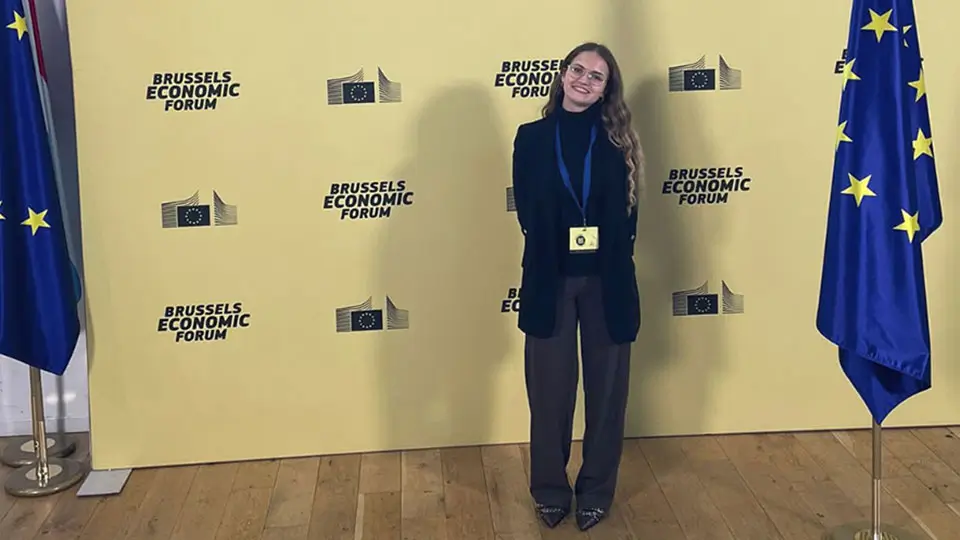
My internship experience was characterized by a rich variety of diverse activities. My workdays were often dynamic; over the course of those three months, I assisted with numerous events—some spanning entire days, others lasting only a few hours. This frequently required me to travel to various locations across Brussels, as well as to the European Parliament, the European Commission, and the European Committee of the Regions. During these events, I would take notes to draft information briefs or create content for social media.
On days without events—aside from a few days of remote work—I would head to the office, located on Rue du Luxembourg within the “Nordic House.” I usually commuted from my apartment by bus, though sometimes I took the metro. Each morning, as I arrived, I could see the European Parliament in the distance. I was supported by a mentor, and for the first half of my internship, I shared the workspace with another intern from France. Although IrRADIARE is a Portuguese company, its team is highly international. Its headquarters are in Algés, near Lisbon, but the firm also maintains a small office in Brussels. Several of my colleagues in Portugal were Italian—just like me—but I communicated almost exclusively in English, and all the work I carried out was, naturally, in English. IrRADIARE is a consultancy firm that supports public entities, businesses, and communities in defining and implementing sustainable development strategies through its participation in European projects. While I lacked specific prior knowledge in this field, the ecological transition is a challenge that resonates deeply with me; consequently, I found it particularly rewarding to be able to make a small contribution to the projects we were working on.
Every morning, after our usual coffee in the fourth-floor kitchen of the Nordic House, we would head to the office to begin our workday. My work week consisted of 35 hours, and the day typically ended at 5:00 PM, unless we were attending longer-running events. I assisted my colleagues with various tasks—such as drafting project proposals, reports, and articles, and researching new initiatives and European funding calls—learning, for instance, how to navigate databases like CORDIS and the Funding & Tenders Portal. I was frequently asked to create presentations using Canva, as well as to build and update spreadsheets in Excel or Google Sheets to track opportunities and contacts for potential stakeholders. Each week, there was a general meeting and a separate meeting for interns, allowing managers to keep track of all our activities while giving us the chance to share our progress and any challenges we encountered.
What was the most memorable moment of living and working in this country? And what was the biggest challenge you faced during your internship?
The most memorable moment of this experience in Brussels was undoubtedly attending the opening ceremony of the New European Bauhaus Festival, which featured European Commission President Ursula von der Leyen, European Council President António Costa, and other prominent speakers. I felt truly fortunate to gain access to these institutions, to witness such significant events within the “European bubble” firsthand, and—in this instance—to hear in person figures whom I had previously only ever seen on the news. It was a moment that made me fully realize where I was and just how valuable the opportunity provided by EU4EU truly was.
At the same time, these very settings presented my greatest challenge. Faced with the stature of the individuals around me, I often felt small or out of place. There were plenty of networking opportunities during various conferences, yet in those moments, I frequently lacked the confidence to introduce myself and strike up a conversation with professionals far more experienced than I. Compounding this was the difficulty of navigating the language of the “European bubble”—a landscape filled with acronyms, abbreviations, and technical terminology that I initially struggled to decipher and needed time to absorb.
As the weeks went by, however, I learned some of this terminology, incorporating it into my own vocabulary. I also began to approach networking situations with greater ease, making an effort to join conversations even when I felt insecure. This challenge taught me that self-confidence is built one step at a time, and that feeling uncomfortable is simply part of the journey.
The Cultural Differences
Can you tell us about the major differences between your country and your host country?
Beyond its size, the feature that most distinguishes Brussels from Bari is undoubtedly its multiculturalism. At the same time, I have never felt too far from Italy, as there are a great many Italians living and working in Brussels. What makes Brussels truly special is that it was already a culturally and linguistically rich city, even before it became so international. Belgium is divided into two major linguistic areas—Dutch-speaking Flanders and French-speaking Wallonia—with Brussels serving as a bilingual region at the center. I also discovered that German is an official language, as there is a small German-speaking community living in the east of the country, along the border with Germany. In my day-to-day life, I haven’t faced any major difficulties, as I speak French quite fluently; however, during a few weekend trips to Flanders, I had to rely on English.
In fact, many people in Brussels live there without speaking any of the official languages. I have witnessed interactions—at a pharmacy or a supermarket, for example—that took place entirely in English. I believe the vast majority of the city’s inhabitants are able to communicate in English, given the city’s profound multiculturalism and the presence of institutions that draw people from all over Europe for work. Indeed, a very significant portion of the residents are of foreign origin, and you can hear all sorts of languages being spoken on the streets. This fosters an open environment where it is easy to feel part of a community, even without a perfect command of the local languages—something that is rarely the case in most Italian cities.
Another positive aspect is the public transport network—both urban and national—which is far more efficient and extensive than what I am used to. Furthermore, in Brussels, students can purchase an annual pass at a very affordable price.
While city transport may be inexpensive, the same cannot be said for other costs: groceries, dining out, and—above all—rent are significantly more expensive than what a student in Bari, or perhaps elsewhere in Italy, is accustomed to. In my view, this makes Brussels a rather inaccessible city for those without financial support. Without the EU4EU scholarship, finding and paying for accommodation would have been, in my case, impossible.
Career development
How has your EU4EU experience influenced your professional goals and career opportunities?
I have not yet finished my studies, so I cannot fully gauge how this experience will impact my job search. However, as I am currently aiming to relocate to France, I believe it will be a significant asset in securing future internships and, eventually, a permanent position. Having worked abroad—using English and collaborating with colleagues of various nationalities—is something that I believe can truly set a CV apart and make a positive impression during interviews, as it demonstrates both adaptability and autonomy.
Regarding my specific career path, I am not yet certain; I would like to gain further experience in different fields before deciding whether EU project management is the right direction for me. Nevertheless, this internship has provided a concrete understanding of the work behind EU calls for proposals and initiatives. I have learned to use tools and databases that were previously unfamiliar to me, and I have gained a clearer sense of which tasks I find most engaging and which I do not.
Furthermore, this experience has helped me become more confident in my professional interactions, improved my ability to organize my work, and given me a better grasp of my own strengths—as well as the areas where I still need to develop. I have realized that networking and high-profile public engagement are not where I feel most comfortable. If I had the choice, I would prefer to work “behind the scenes”—delving into specific topics, analyzing calls for proposals and funding opportunities, organizing information, and managing contacts, while also contributing to the planning and drafting of proposals to support those who handle the more relationship-driven aspects of the work. I consider this a valuable insight, as it helps me identify the roles and work environments that best align with my aptitudes—without, however, shying away from challenging myself when the situation calls for it.
Advice on the EU4EU programme
If you could give one piece of advice to a student considering an EU4EU internship, what would it be and why?
For a student planning to participate in an EU4EU internship, my first piece of advice is to focus on improving your English; a strong command of the language is essential both for the selection process and for working in an international environment on a daily basis. I also suggest completing each step outlined in the call for applications as quickly as possible—this will help you earn more points in the ranking—and avoiding last-minute tasks, as there are many deadlines and the preparation process takes time.
I would also recommend researching and looking for good examples to help you craft a CV and a cover letter that are comprehensive yet concise and well-targeted. These documents serve not only as your initial introduction to host organizations during the “Matching Phase,” but they also carry the most weight in your ranking score, as they are evaluated based on how well they align with the program’s educational objectives and the specific duties of the internship. For this reason, it is well worth spending time exploring the open positions on the portal and reaching out early to organizations that best match your academic background and personal interests. Once you secure an interview, thorough preparation is key: learning about what the host organization does allows you to demonstrate a genuine interest in the specific role, rather than just an interest in the experience of living abroad.
Finally, for those who are selected, my main piece of advice is to approach this experience with a willingness to step out of your comfort zone, while remaining curious and open to different cultures and environments. You will inevitably encounter challenges—from finding accommodation and handling administrative paperwork to the occasional feeling of being out of place—but it is precisely these challenges that foster growth and personal and professional enrichment.